
The Secret Keeper & The Strategist: Fannie Lamar Gately

Introduction: A Legacy of Loyalty
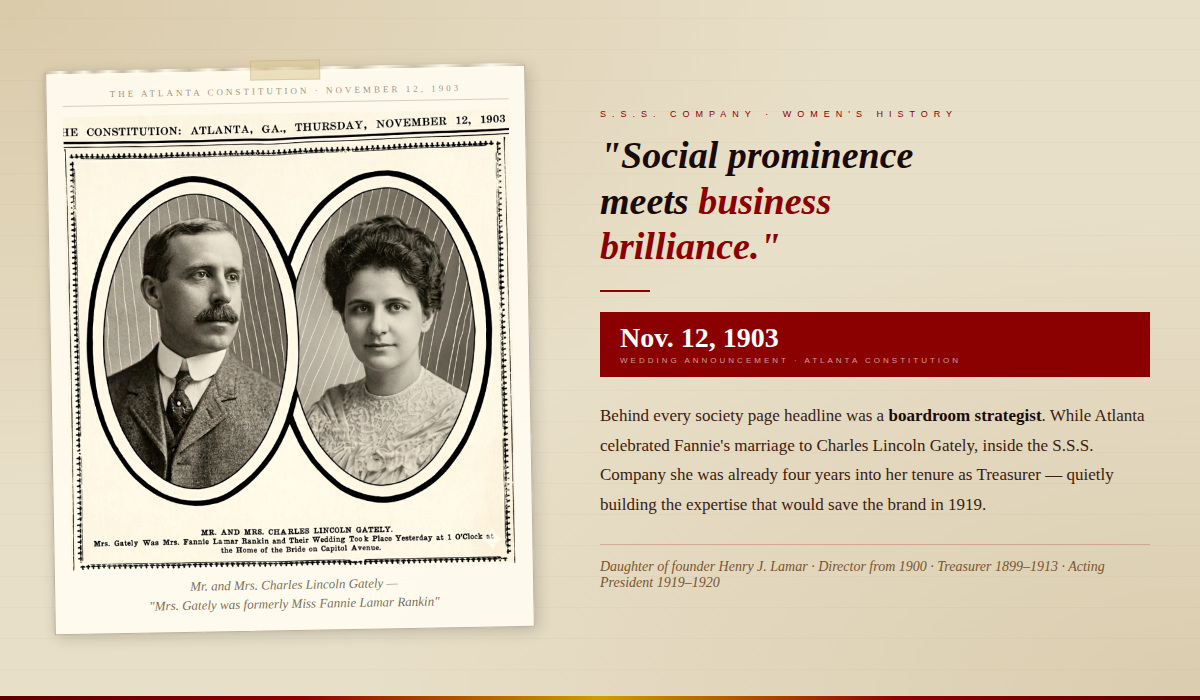
Some leaders are born, and others are built. Fannie Lamar Gately (formerly Fannie Lamar Rankin) was both. She was the daughter of Henry J. Lamar, one of the founding pillars of the S.S.S. Company. Fannie had the business in her blood. But she didn't just inherit a title; she spent decades earning her place as one of the most powerful women in the health industry.
The Multi-Hyphenate Executive
Fannie’s resume reads like a masterclass in corporate endurance. She didn't just hold one role; she mastered every corner of the company:
- Treasurer: She managed the company’s finances for 12 years, serving as Fannie Lamar Rankin starting in June 1898 and continuing as Fannie L. Gately through June 1910.
- Director: She was elected to the board of directors on June 15, 1900.
- Acting President: She led the company as the Acting President from July 2, 1919, to January 26, 1920.
The High Stakes of 1919: Prohibition & The Secret Formula
The year 1919 was a turning point for America. The National Prohibition Act was looming, and every product containing alcohol was under the microscope. This is where Fannie’s leadership truly shone.
She was one of the elite few entrusted with the quantitative formula for the Beal Preservative. This wasn't just a recipe; it was a scientific breakthrough developed by Prof. J. H. Beal to reduce the alcohol content in S.S.S. Tonic without losing its potency.
Fannie wasn’t just overseeing the books from afar; she was the literal guardian of the brand's survival. To protect the proprietary Beal Preservative formula, she established a private mailing address at 960 Peachtree Street to correspond with consulting chemists. This ensured that the identities of Chemicals #1, #2, #3, and #4—the coded names for the secret ingredients that saved S.S.S.—remained strictly confidential. By using these codes and omitting her title from all envelopes, Fannie ensured that even if a letter was intercepted, the recipe that allowed S.S.S. to survive Prohibition remained a family secret known only to five elite individuals.
Fannie spearheaded the correspondence with top chemists like Samuel P. Sadtler to prove to the government that our tonic was a legitimate medicine, not a beverage. She was literally the guardian of the brand's survival.

Revamping the Medical Department
Fannie’s leadership wasn't just about protection; it was about progress. Following the Louisiana affair in 1919, she directed a total revamp of the company’s medical department. She ensured that every piece of communication directed users to consult physicians for serious conditions, setting a standard for medical ethics that was far ahead of its time.
During this era of modernization, Fannie oversaw the department’s most significant expansion, with costs reaching a peak of $11,208.06 in 1920. She personally directed the destruction of over $11,400 worth of outdated advertising in 1919 to ensure S.S.S. met the highest new standards of medical ethics following the Louisiana affair.
Connecting to Today: A Mother’s Friend
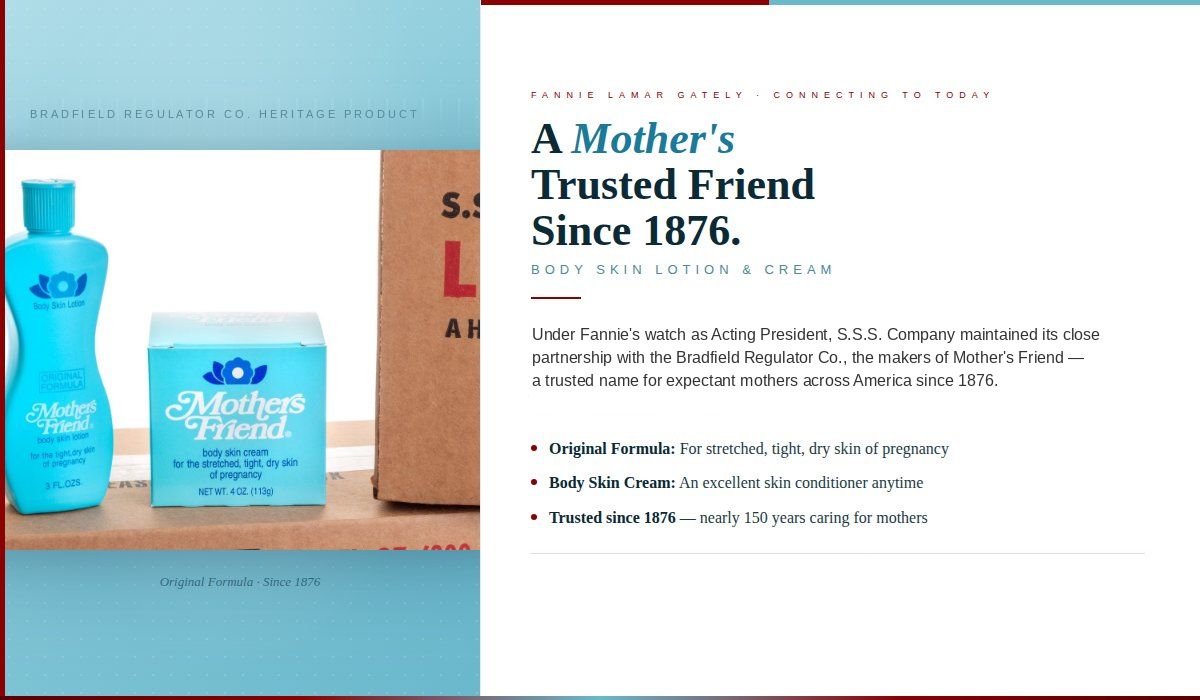
Fannie’s influence extended beyond the Tonic. She oversaw the era when Mother's Friend became a household name for expectant mothers. Her dual role as a high-level executive and a mother of four gave her a unique perspective on women’s health.
A Dynasty of Strength
Fannie’s dedication to the family trust was reflected in her care for the next generation. In 1913, she helped secure a $10,000 life insurance trust for her children, and her daughter Alberta Lamar Rankin eventually carried the Lamar name and spirit of service forward into the next era of S.S.S. history.
Her resolution in 1913 was not just about insurance; by acting as a trustee for her children, she ensured that the family’s majority interest in the company remained unified and protected, a trust that remained unbroken for over a century.
Fannie’s influence was so enduring that in 1941, decades after her presidency, the Board of Directors officially recorded a tribute to her role as one of the firm's foundational leaders. They honored her for maintaining the noble austerities and repelling virtues— including unswerving conscientiousness and unbending dignity that allowed the S.S.S. Company to survive the turmoil of the early 20th century and the challenging era of Southern reconstruction.
The Takeaway: Fannie Lamar Gately proves that leadership isn't just about being in charge; it's about being the smartest person in the room when the stakes are highest. This International Women's Month, we salute the Secret Keeper who kept S.S.S. strong. As one of the successors who unswervingly preserved the original formula, Fannie embodied the corporate ideals of unfailing industry and unyielding devotion to duty. At a time when men were overwhelmingly heads of companies and women were barely represented in corporate spaces during the early 20th century, Fannie's leadership demonstrates that women make excellent leaders, too. They deserve to be mentioned along with other titans of industry in the early 20th century (such as Rocafella and Carnegie).