

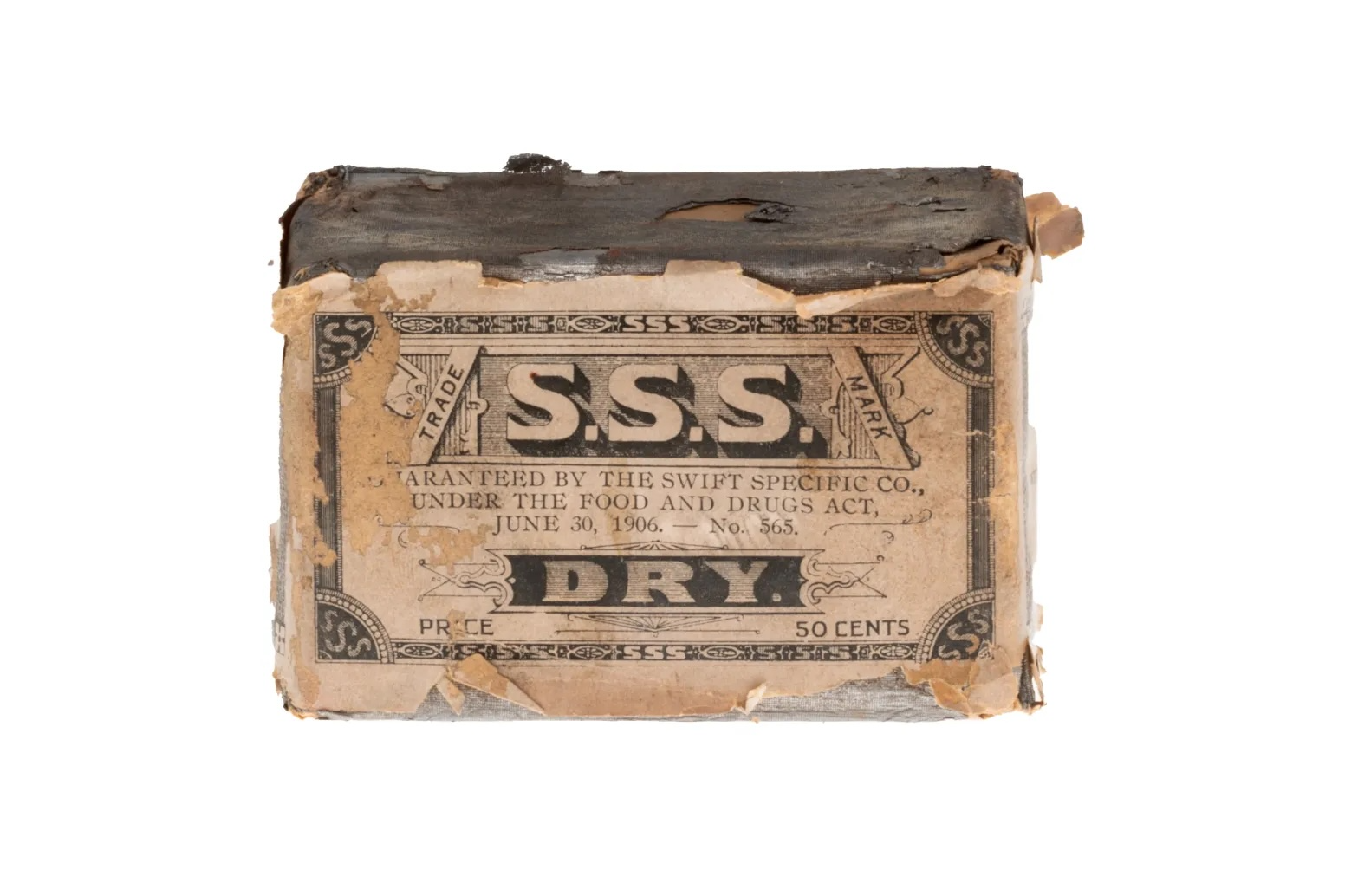
S.S.S. Dry Box - History of a Rare Early S.S.S. Product
The S.S.S. Dry Box is one of the earliest documented products created by the Swift Specific Company (S.S.S.). The liquid tonic first entered commercial production in 1867, but the business soon expanded its offerings by introducing the S.S.S. Dry Box, a version of the remedy that had been acquired in 1826 and used in domestic practice both before and after that date. The dry product consisted of ground roots packed into a quarter-pound box and retailed for 50 cents.1
What Exactly Was the S.S.S. Dry Product?
Customers steeped the contents in hot water to make a tea, a method that aligned naturally with familiar household preparation methods used for herbal remedies at the time. This was a direct continuation of the original 1826 formula, which was traditionally prepared by boiling specific roots for three days. Today, surviving boxes are scarce, and their materials and typography provide valuable insight into early S.S.S. branding and production.
During this early era, the product relied on three primary botanical roots: White Ash (Fringe Tree), Thunderwood (Swamp Sumac), and Sumac. These original ingredients were traditionally valued for their specific effects:
- White Ash was often used for its alterative and tonic properties.
- Thunderwood (also known as Mercury Vine) was utilized for skin eruptions.
- Sumac was credited as an antiseptic.
Today, surviving boxes are extremely rare, and their materials and typography provide valuable insight into early S.S.S. branding and production.
While later narratives often attribute the formula to a Cherokee chieftain, the earliest records indicate it was a "secret remedy" of the Creek (Muskogee) Indians, reduced to writing by Captain H.L. Dennard in May 1826 as the Creeks were yielding their lands in Georgia.

A Closer Look at the Vintage Label
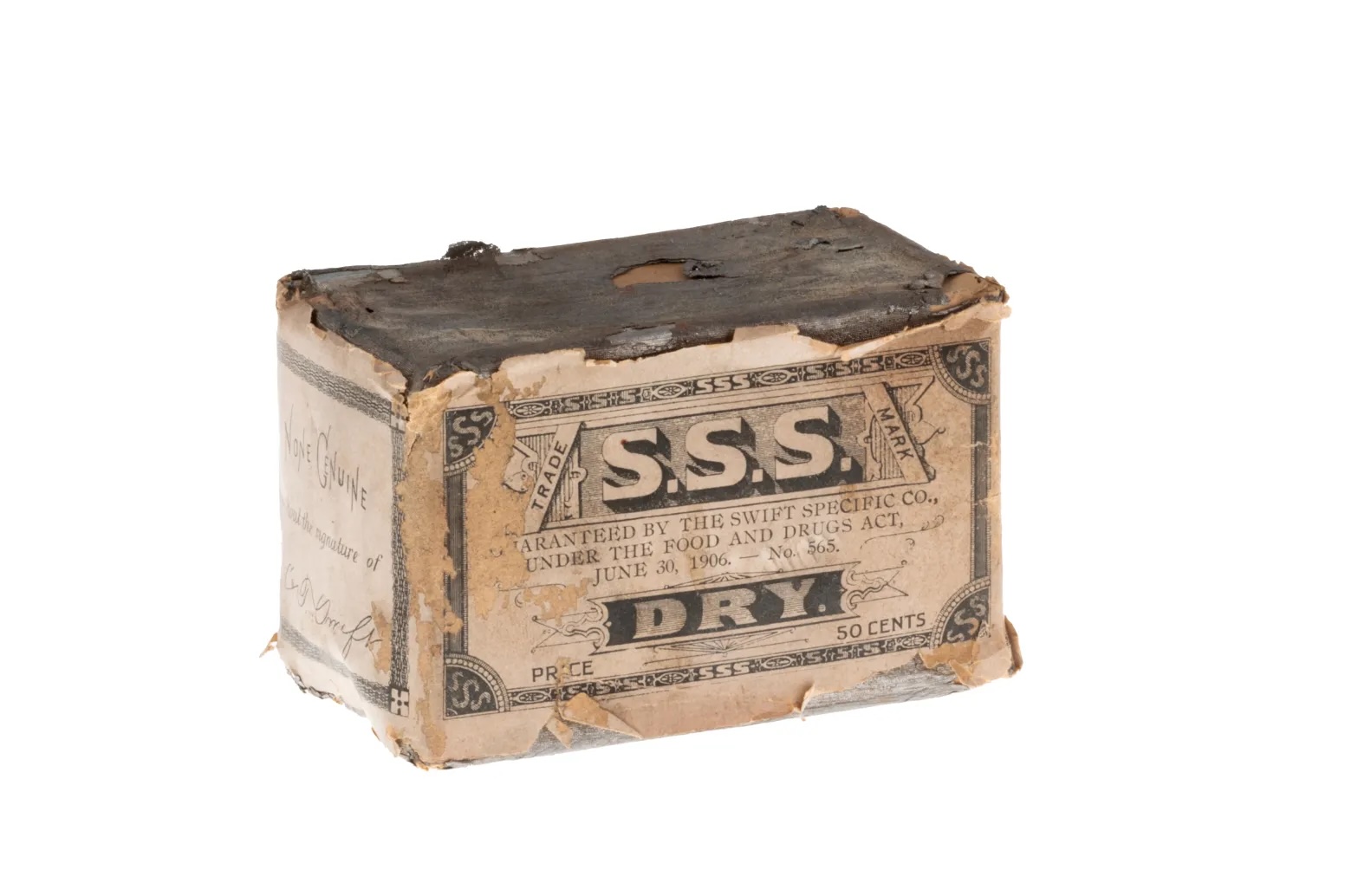
The front panel of the S.S.S. Dry Box displays one of the earliest examples of federal compliance language used by the company. The guarantee reads:
“Guaranteed by The Swift Specific Co. under the Food and Drugs Act, June 30, 1906—No. 565.”1
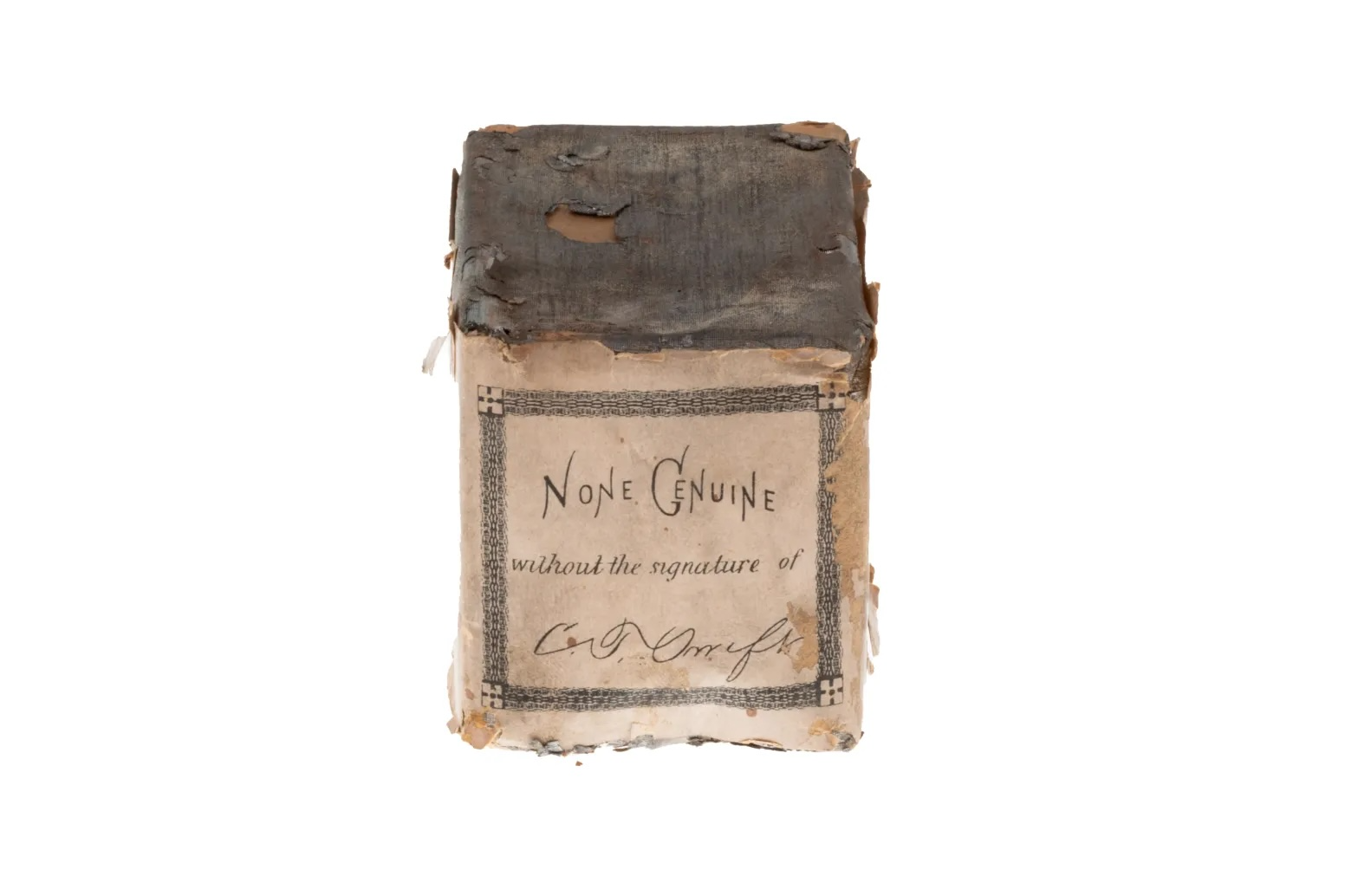
Additionally, the side panel includes the complete anti-counterfeit signature message:
“None genuine without the signature of C. T. Swift.”1
This referred to Colonel Charles T. Swift, the company’s founder, who had purchased the original formula for a nominal sum after serving in the Infantry of the Confederate Army
By July 1886, the company had adopted an even more elaborate strip over the neck of the bottle to prevent counterfeiting. This updated design featured the facsimile signatures of both founder Charles Thomas Swift and Jesse Willis Rankin. Rankin was a prominent Atlanta pharmacist and civic leader who served as the company’s first Secretary and Manager.
During this period, the packaging famously featured a $1,000 reward offer for anyone who could prove the product contained 'one particle of Mercury, Potash, Arsenic, or other mineral'. While this served to reassure customers of the product's 'purely vegetable' nature, internal scientific evaluations eventually revealed that many minerals, including Potash and Arsenic, actually occurred naturally in the botanical roots.
These statements illustrate both the company’s early branding strategy and its efforts to comply with newly-enforced federal regulations.
Historical Inventory Records Reveal Its Decline
Internal company notes reveal that the commercial success of the S.S.S. Dry Box was tracked primarily through inventories of packaging materials, because sales records and the general ledger did not differentiate between the dry and liquid versions.1
Records further show that sales dwindled after 1900, with only small amounts of packaging material remaining in inventory as late as 1911 and 1912.1 While the dry product was a staple in the late 1800s, by 1911 and 1912, inventory records show only a 'small quantity' of the dry material remained in stock. This period marked the company's final transition to a solely liquid-based manufacturing process.
This decline foreshadowed the product’s eventual discontinuation, which aligned with both scientific findings and changing consumer preferences.
Why the S.S.S. Dry Box Was Discontinued
In 1917, the company expanded its botanical profile from the original three roots to six, adding Queen’s Delight, Prickly Ash, and Poke Root. This complexity made the standardized, high-volume steam extraction used in liquid production significantly more effective than older dry-root methods.
Multiple scientific, operational, and commercial factors contributed to the end of the S.S.S. Dry Box, as evidenced by the following comparative data:
| Extraction Method | Iron Content (mg per 100 c.c.) |
Effectiveness in Test Animals
|
| Regular S.S.S. Liquid (Steam on fresh roots) | 15.2 mg |
Responded to treatment; returned to normal
|
| Dry Root Extract (Steam on dry roots) | 5.1 mg |
Maintained state but did not increase hemoglobin
|
| Fresh Root Alcohol (Type A Process) | 5.6 mg |
Decided drop in hemoglobin after two weeks
|
| Dry Root Alcohol (Type A Process) | 2.9 mg |
Decided drop in hemoglobin after two weeks
|
- Loss of medicinal value: Scientific studies conducted in 1930–1931 confirmed that once the roots dried completely, they became “without medicinal value.” Experiments showed that extracts from dry roots were ineffective in regenerating hemoglobin in test animals. Additionally, a comparison revealed that an extract from dry roots contained only 5.1 mg of iron per 100 c.c., while the regular S.S.S. liquid contained 15.2 mg per 100 c.c..1 Scientific testing under Dr. J. L. McGhee demonstrated that the traditional 'Type A' alcohol extraction method (using dry roots) failed because the vital metallic matter—specifically iron—is largely insoluble in strong alcohol. Furthermore, the company discovered that using dry roots resulted in a significantly lower iron assay of 5.1 mg per 100 c.c., compared to 15.2 mg when using the proprietary steam extraction on fresh, green roots.
- Superior steam-extraction process: The company’s patented steam extraction method used for the liquid tonic successfully extracted more iron and key ingredients while the roots were still fresh and green. This process proved superior to both dry-root and alcohol-based extraction methods.1
- Shifting consumer habits: Customers increasingly preferred ready-made tonics rather than preparing teas at home.
- Operational efficiency: Maintaining packaging materials for a declining product became impractical.
A Meaningful Artifact in the S.S.S. Legacy
Although discontinued long ago, the S.S.S. Dry Box remains an important piece of S.S.S. Company history. Its label, scientific findings, and archival records document the company's transition from traditional herbal preparations to scientifically refined formulations.
To explore additional artifacts and historical documentation, visit the S.S.S. History Collection.
Eventually, the company was forced to remove all 'cure' claims from its packaging to comply with the Bureau of Chemistry’s evolving standards. By June 1919, a 'New Style Package' was adopted that eliminated specific disease claims and the $1,000 reward offer, moving instead toward a more conservative 'Alterative Tonic' description.
References
- S.S.S. Company Internal Notes & Scientific Findings (1930–1931), Inventory Records (1900–1912), Packaging Statements including federal guarantee text and the C. T. Swift signature panel.