
The original liniment had a dual chemical structure—lanolin and an oil/soap base—whose two components later became the foundation of today’s separate Liquid and Cream formulations.2 This historical exploration examines the product’s origins, its formula split, the decades-long corporate affiliation that preceded the 1954 merger, and the evolution from patent medicine to a modern skincare product.
Because this article includes historical advertising language, it’s important to note that modern Mother’s Friend is positioned as a skin-comfort and moisturizing product—not as a treatment intended to affect labor outcomes. If you have questions about use during pregnancy (including sensitive areas, allergies, or irritation), consult your healthcare provider.

Marketing and Origins of Mother’s Friend
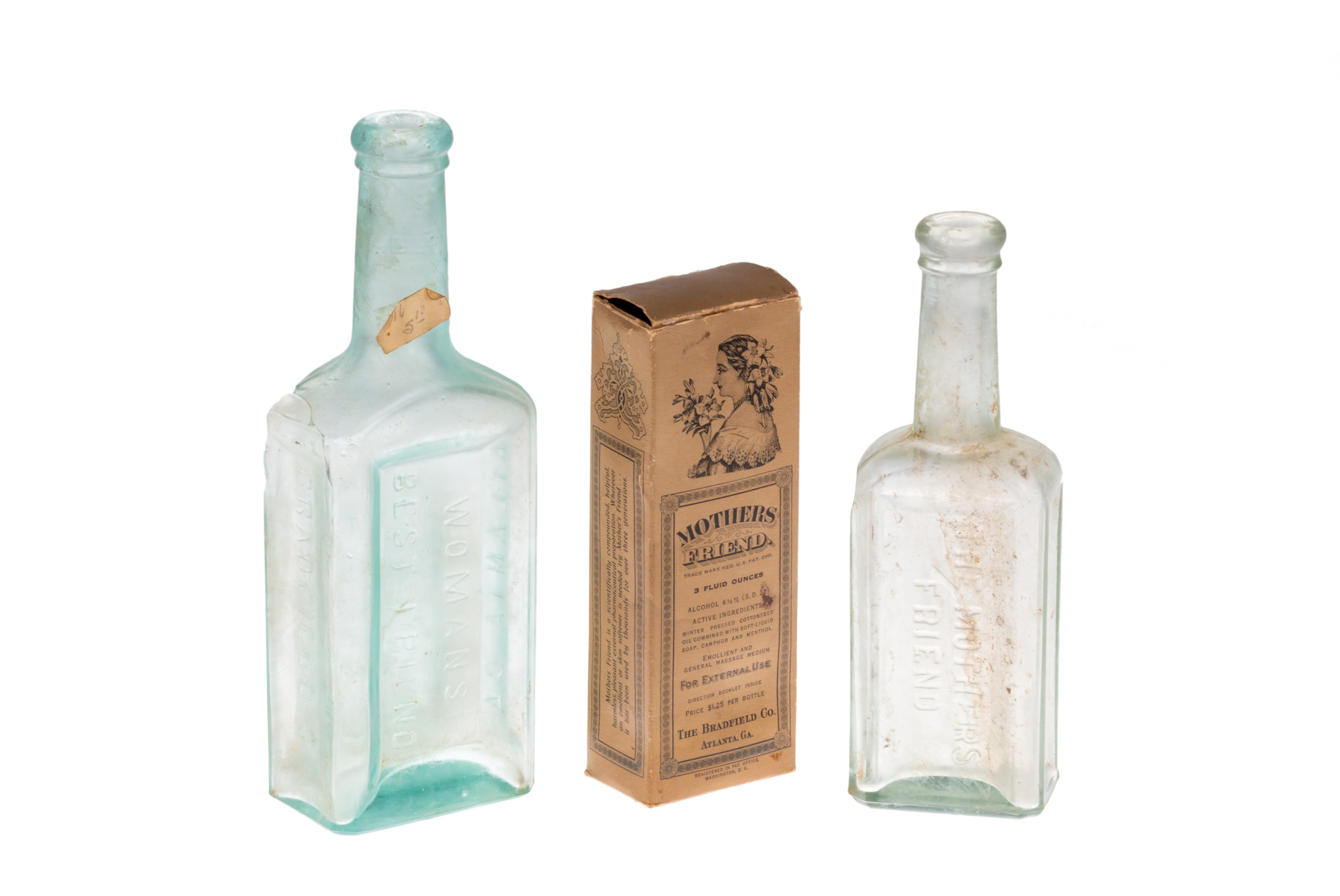
The remedy was originally formulated by Dr. Joseph Bradfield, an Atlanta physician whose “Regulator” company became a cornerstone of the city’s early pharmaceutical industry alongside the developers of S.S.S. Tonic.
While Dr. Bradfield created the original “Regulator” formula, the S.S.S. Company history credits the broader commercial success of this tightly connected corporate circle to the vision of Col. H. J. Lamar, Col. C. T. Swift, and J. W. Rankin. In this context, the “corporate circle” refers to the network of Bradfield, S.S.S. Company, and their related enterprises that shared founders, officers, and laboratory space while remaining legally distinct companies.3
Manufacturing was underway as early as 1876.2 On February 10, 1884, Bradfield Regulator Company claimed continuous trademark use for “Remedies for Female Use.”4 On December 17, 1886, Bradfield filed the official trademark for “THE MOTHER’S FRIEND.”5
While manufacturing activity began in 1876, the sister entity that would later consolidate and govern the broader corporate organization was established later. The Swift Specific Company was formally incorporated on June 13, 1879, establishing the legal foundation of the sister corporation separate from the Bradfield manufacturing start date.
This managerial linkage was further solidified by W. A. Loyless, who served as Secretary and Manager of the S.S.S. Company from March 1, 1892, to August 10, 1894, while simultaneously directing the Bradfield Regulator Company from the third floor of the same laboratory building.3
Early Mother’s Friend advertising promised easier labor, reduced pain, and healthier babies—claims typical of the patent medicine era. Those claims reflected the marketing norms of the time rather than modern product positioning; today, the brand is presented as a topical skincare product focused on moisturizing and improving skin comfort.
Original Formula and Early Claims

Chemical analysis of excavated bottles shows the original liniment had a dual composition:
- Lanolin, a natural emollient.2
- Oil-and-soap base, typically winter-pressed cottonseed oil blended with soft liquid soap.6
Post-1909 packaging reveals the regulated formula: Winter-Pressed Cottonseed Oil, Soft-Liquid Soap, Camphor, Menthol, and Alcohol 6.5%. This matches the modern Liquid Lotion.6
The corporate circle applied its broader manufacturing standards to Mother’s Friend, rooted in the philosophy that botanical ingredients must be processed in their fresh state. This belief—central to the sister company’s S.S.S. Tonic—held that active plants extract significantly more metallic matter from the soil than when dormant, and that these virtues are lost during the drying process.
These theories were based on the idea that during a state of osmosis, active plants extract significantly more metallic matter (iron, copper, manganese, arsenic) from the soil than when dormant. Researchers warned that plants lost a significant portion of their medicinal virtues during the drying process. These ideas were subjected to evaluation by specialized researchers McGhee, Kracke, and Eddy, in collaboration with institutions such as Emory and Columbia University, whose studies helped validate the physiological effects of the company’s internal tonics and influenced the high research standards applied across the corporate circle’s products.7
While lanolin was a key later addition, company inventory records show that glycerine (a common pairing for skin-softening agents) did not appear in the company’s manufacturing records until March 31, 1894.1
New Federal Government Regulations Impacted Marketing and Positioning
The 1906 Pure Food & Drugs Act required truthful labeling and prohibited exaggerated therapeutic claims. In 1909, two consignments of Mother’s Friend were seized for misbranding.1 The brand survived by shifting its marketing toward topical comfort and skin softening.
- Preemptive Strategy: The elimination of medical claims was largely a strategic response to the Bureau of Chemistry (the precursor to the FDA) seizing other products. The sister company preemptively removed all therapeutic claims from its cartons on June 16, 1919, to avoid further conflict.
- The Louisiana Affair & 1919 Revision: This revision was heavily influenced by a conflict with the Louisiana State Board of Health beginning in May 1919, which notified druggists that the product should be classified alongside venereal disease nostrums. The sister company preemptively removed all therapeutic claims from its cartons on June 16, 1919. This led to the company's formal resolution on July 1, 1919, to revamp all medical form letters and include the specific disclaimers currently found in the company's archives.
- Landmark Stipulation: A landmark 1934 stipulation with the Federal Trade Commission permanently altered the brand's advertising strategy, requiring that all therapeutic results be qualified as effective only when symptoms were due to specific underlying deficiencies.
- Alcohol Adjustments: During the Prohibition era, the company faced intense scrutiny from the Treasury Department. Although Mother’s Friend was a strictly topical liniment and never intended for internal consumption, regulators evaluated all alcohol-containing preparations to determine whether they might be used as beverages. Mother’s Friend avoided being banned or taxed as liquor by maintaining a low 6.5% alcohol content. The “unsuitable for use as a beverage” ruling was officially won on September 18, 1914 (Citation No. L 77,124), following a government chemist's opinion that the preparation was not “medicated up to the standard” required for alcoholic compounds.
- Classification: While “Alterative Tonics” were traditionally internal remedies, the corporate circle utilized this standardized classification to satisfy the Bureau of Chemistry's evolving requirements for botanical compounds, even as Mother's Friend maintained its identity as a strictly topical liniment.
Mother’s Friend in Early Women’s Healthcare
During the late 19th century and into the early 20th century, there were few commercially produced skincare lotions or creams available to support pregnant women in maintaining healthy skin. Many women relied on homemade remedies made from common household ingredients to address dry, itchy, and sensitive skin during pregnancy. Against this backdrop, Mother’s Friend emerged as one of the first readily available products specifically marketed for maternity skincare. Its ease of use and growing availability helped establish it as a trusted and familiar part of home-based maternity care for women in many communities.8
Corporate Affiliation and the 1954 Merger
The long-standing relationship between the Bradfield Regulator Company and the S.S.S. corporate organization culminated in a formal legal consolidation. The Bradfield Regulator Company formally merged into The Swift Specific Company on December 31, 1954, establishing definitive corporate ownership and governance within the S.S.S. structure.3
- Physical Proximity: The bond (physically rooted in Atlanta) between the two companies was more than administrative; in the 1890s, the Bradfield Regulator Company was located on the third floor of the S.S.S. Company Building at the corner of Hunter and Butler Streets in Atlanta.3
- Shared Leadership: Beyond sharing J. W. Rankin as an officer, the companies’ shared resources were described as preserving the interests of the founding families; from 1881 through the mid-20th century, no stock was sold or transferred except to descendants.3
- Legal Authority: As early as August 18, 1934, S.S.S. legally amended its charter to officially permit the organization of subsidiary corporations, providing the legal framework for later brand acquisitions.3
The overall operation of both companies functioned much like a family trust: from 1881 through the mid-20th century, stock in the core businesses was transferred only to family members or descendants. This linkage between S.S.S. and Bradfield was reinforced by W. A. Loyless, who served as Secretary/Manager of S.S.S. (1892–1894) while simultaneously managing the Bradfield Regulator Company from the same building.3
1964–1965 Operational Control and Modernization
- 1964–1965 operational control: S.S.S. marketed Mother’s Friend, introduced plastic packaging, and included the product in major export orders. The brand's international reach was established remarkably early; corporate records show that 50 cases of the product were sold for trade in China as early as 1916.3
The Formula Split: How One Liniment Became Two Modern Products

The modern split was made practical through Bentley’s “home-formulation” work on the Liquid line. In this context, “Bentley” refers to a formulator associated with internal product-development notes: the work focused on refining the traditional oil-and-soap preparation into a consistent, standalone Liquid product that could be made reliably and used comfortably as a daily skincare lotion. That refinement made it easier to preserve the original formula’s second component—lanolin—as a separate Cream product, so both halves of the historic dual composition could continue in two modern, stable formats.
The modern Liquid (oil/soap) and Cream (lanolin) formulations reflect the original dual composition. This chart provides a breakdown of the product evolution.
| Era | Product Form | Primary Ingredients | Closure/Case |
| Late 1800s | Original Liniment | Fresh Botanicals, Oil, Soap | Corked Glass / Wood Cases |
| 1918–1929 | Regulated Formula | Cottonseed Oil, Soap, Menthol | Metal Cap / Corrugated Case |
| Modern | Split Formulations |
Liquid: Oil/Soap; |
Labeled Plastic |
Advertising and Cultural Influence
To maintain sales and build long-term consumer trust, the corporate circle relied heavily on distributing millions of educational booklets (The Blood is the Main Spring, Something Every Man and Woman Should Know, and Nature's Message to You) and offering free medical advice through a “Medical Department.”
The company also built trade loyalty by providing druggists with practical medical-themed gifts, including iron twine pots, umbrella stands, and apothecary weights. By the mid-1960s, the brand's reach had expanded into the international export market, with significant orders shipped for trade in regions like China. S.S.S. Company archives note that the Liquid formula required continual recruitment of new users due to occasional use patterns.3
- Demographic Reach: While many patent medicines faded, Mother’s Friend maintained a deep cultural footprint in the rural American South. It became a staple of “granny midwifery” and home-based maternity care, eventually becoming one of the few legacy brands to successfully transition its marketing into mid-century African American publications like Ebony.
Mid-century advertising emphasized modern packaging rather than sweeping medical claims.
Packaging Evolution Through the Decades
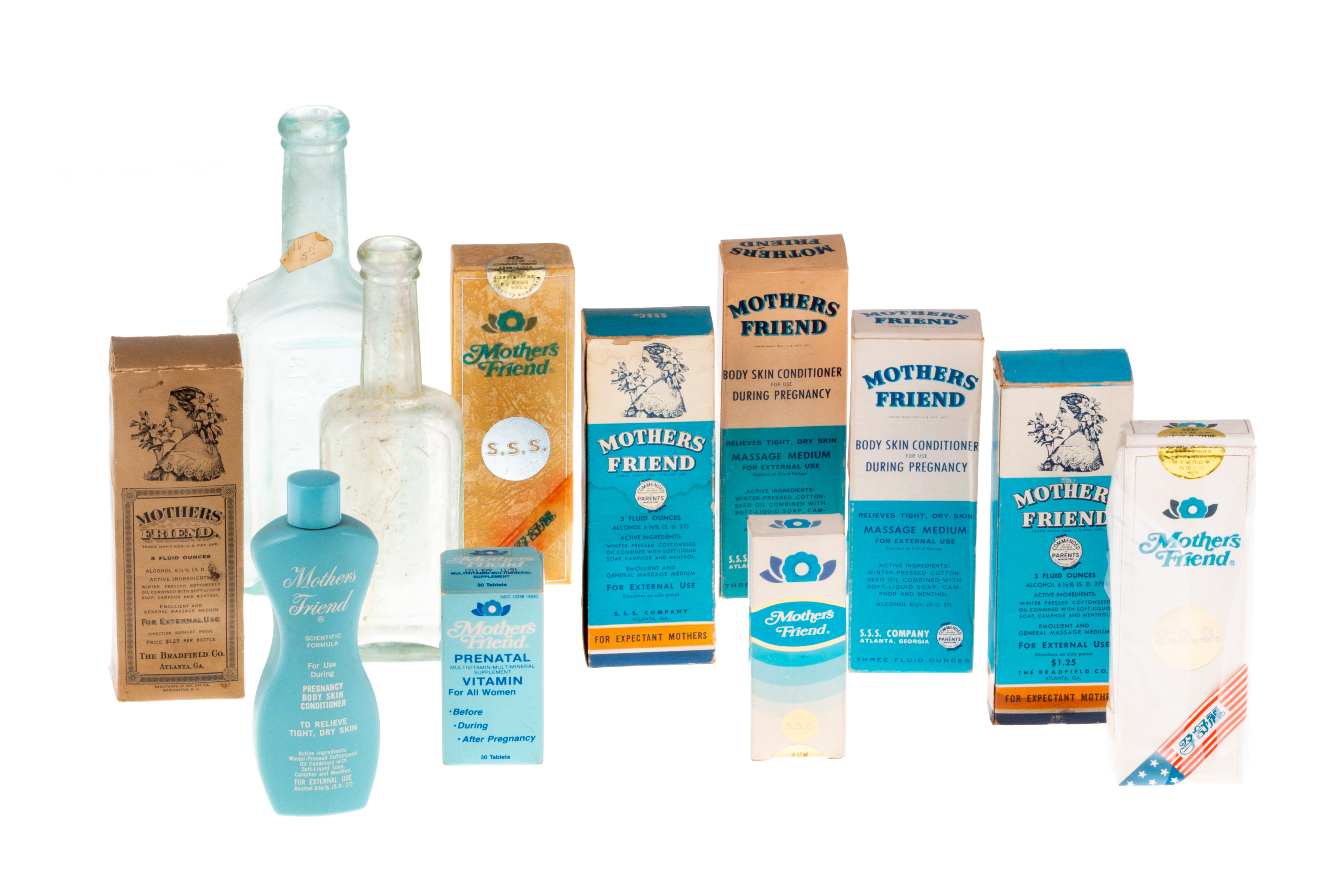
The brand evolved from embossed glass bottles to labeled glass, metal caps (1929), and molded plastic bottles introduced in the 1960s.3
- 1918 Milestone: In 1918, the brand modernized its logistics by replacing traditional heavy wooden shipping boxes with corrugated shipping cases.
- 1929 Transition: The transition from traditional corks to metal caps was completed in 1929 to improve shelf stability and manufacturing efficiency.
- 1933 Branding: To further modernize the product’s shelf appeal and appearance, the company began wrapping its cartons in cellophane in 1933.
Comprehensive Timeline of Mother’s Friend History
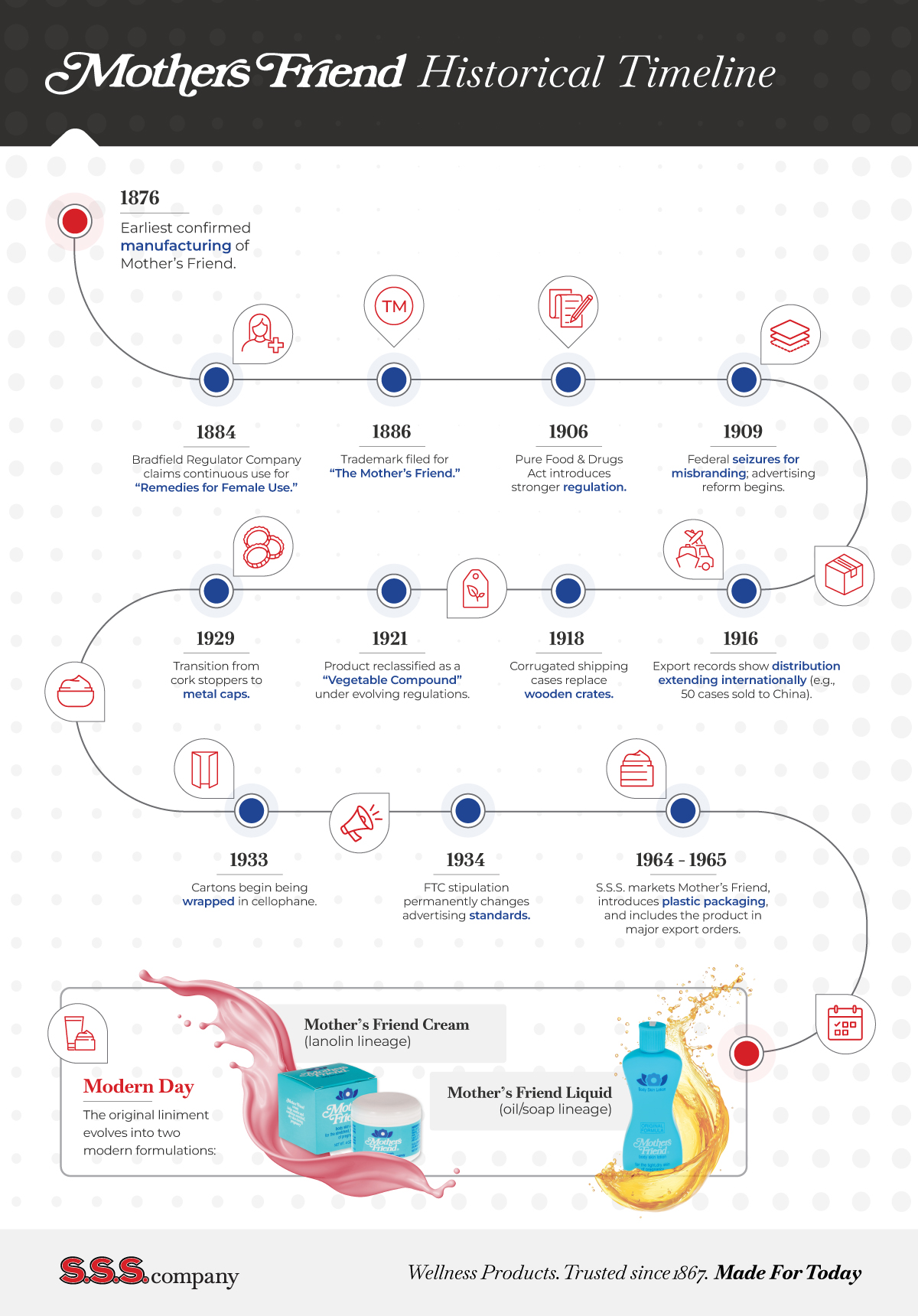
- 1876 – Earliest confirmed manufacturing.2
- 1884–1886 – Trademark filings.4 5
- 1906 – Pure Food & Drugs Act.
- 1909 – Federal seizures.1
- 1921 – Under regulatory pressure to standardize drug classifications, the company added a face label identifying the product as a “Vegetable Compound,” adopting the “Alterative Tonic” terminology used for the broader corporate line despite the product’s topical nature.
- Early–Mid 20th Century – Corporate affiliation documented.3
- 1964–1965 – S.S.S. operational control and modernization (plastic packaging and export expansion).3
Mother’s Friend Today
Today, the product is sold in two versions: the lanolin-based Cream and the oil/soap-based Liquid. The evolution of Mother’s Friend demonstrates how a single formulation has been adapted across eras. Its two modern products preserve the core chemical components first introduced in the 1870s, reflecting a rare continuity between nineteenth-century pharmacy and modern personal wellness.
While Mother’s Friend is best known for maternity skincare, many customers also use it as an everyday moisturizer for men and women—and for older kids/teens who experience dry or tight skin from weather, frequent washing, or daily activity. People commonly apply it anywhere skin needs extra comfort, such as hands, elbows, knees, heels, shoulders, and lower back.
As with any skincare product, avoid use on broken skin and discontinue use if irritation occurs; for children or sensitive skin, it’s best to check with a healthcare professional first.
In modern use, customers most often describe Mother’s Friend Cream as a daily moisturizer that absorbs comfortably and helps support a feeling of skin softness and comfort as the body changes. Many people report using it once or twice daily (often after a shower) to keep skin feeling hydrated and less dry or itchy; some also share that consistent use helped them feel more confident about the appearance of stretched skin over time (results vary by individual).9
References
- 1. Cook, David L. Medicinal Vessels of the First Gilded Age (1870–1929). Georgia State University, 2014.
https://scholarworks.gsu.edu/history_theses/68/ - 2. Caves, Lauren. Chemical & Archaeological Analysis of Mother’s Friend. Phoenix Project / HIP-SI Artifact Study.
https://martaphoenixproject.gsuanthropology.com/items/show/85 - 3. S.S.S. Company Corporate History Records. Internal archival materials documenting officer overlap, shared facilities, export records, packaging evolution, and operational control in the mid-20th century.
- 4. Official Gazette of the United States Patent Office (1884).
https://books.google.com/books?id=J1c4AQAAMAAJ - 5. Official Gazette of the United States Patent Office (1886).
https://books.google.com/books?id=J1c4AQAAMAAJ - 6. Phoenix Project Laboratory Analysis (c. 1909–1915).
https://martaphoenixproject.gsuanthropology.com/ - 7. Institutional Research Division Records documenting studies by McGhee, Kracke, and Eddy in collaboration with Emory University and Columbia University.
- 8. “1800s American Skincare Recipes.” Dusty Old Thing. Reference article documenting common homemade skincare practices used by women in the late 19th and early 20th centuries. https://dustyoldthing.com/1800s-american-skincare-recipes/
- 9. S.S.S. Pharmaceuticals. “Mother’s Friend Cream For Stretched, Tight, Dry Skin (4 oz)” (product description & customer reviews).
https://ssspharmaceuticals.com/products/dermatologicals/mothers-friend-cream