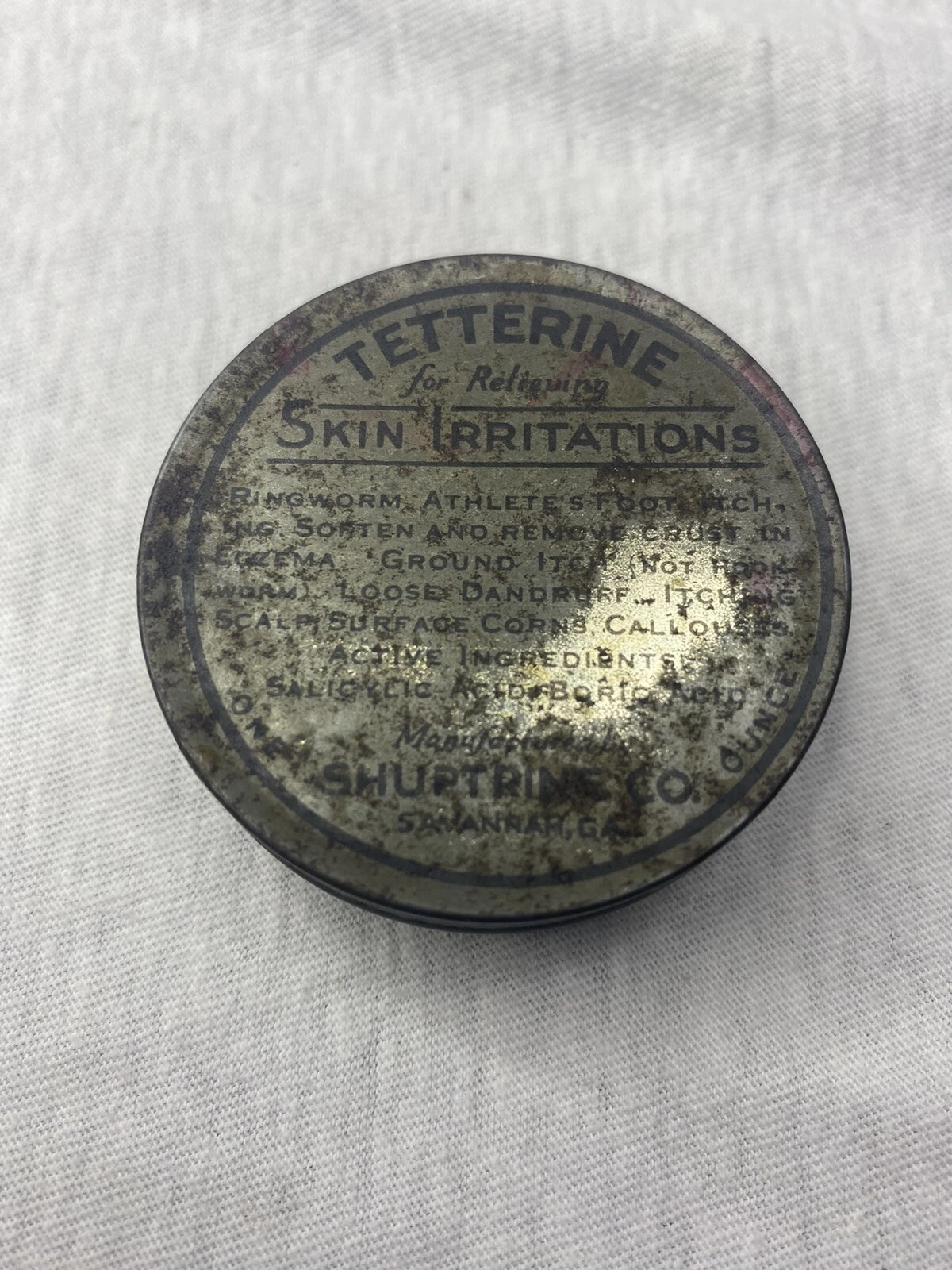
Tetterine History and the Medical Meaning of “Tetter”
People have used "tetter" to describe skin conditions for a very long time. In the 1600s, Shakespeare used the term in Hamlet to illustrate crusty, vile, and leprous skin.1 In eighteenth- and nineteenth-century medical usage, the word “tetter” broadly described scaly, itching, eruptive skin disorders.2 It was not a precise diagnosis; instead, it often served as a catch-all term for conditions now classified as eczema, dermatitis, fungal infections such as ringworm, and other inflammatory or scaling skin complaints.
Before the twentieth century, dermatology was not yet a laboratory-based specialty.3 Skin conditions were frequently classified by appearance rather than by microbiology. As knowledge of fungal causes and infection control slowly developed, consumers relied heavily on topical ointments, medicated soaps, and salves marketed to soothe itching, soften scaling, and reduce visible irritation.
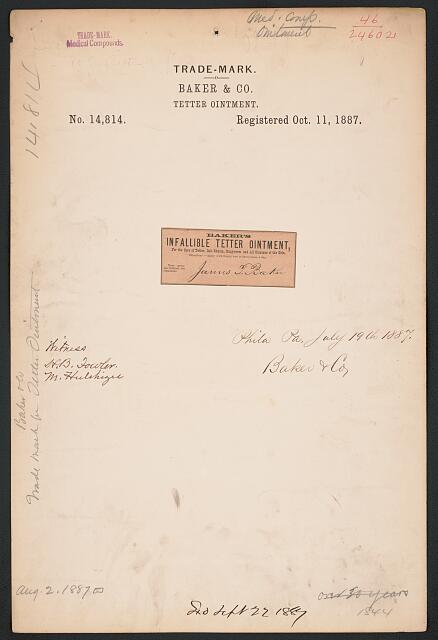
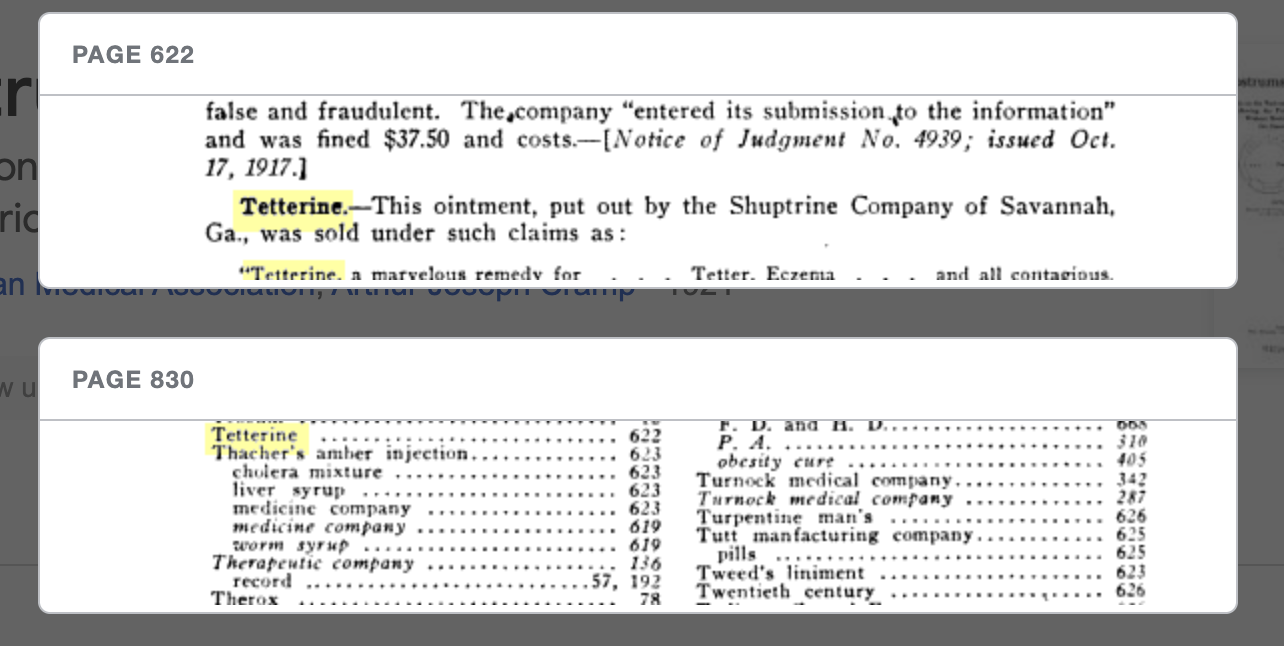
Later reform-era publications, including the second edition of the American Medical Association's Nostrums and Quackery and government reports, examined proprietary dermatological products and discussed them in the context of broader concerns about labeling, oversight, and public protection.4,5 These sources help place Tetterine within the national transition from the patent-medicine era to more standardized regulation.6
Historical Context: Early Antifungal and Skin Remedies
Long before modern OTC antifungals and standardized active-ingredient labeling,7 topical skin remedies were designed around what people could see and feel: itching, scaling, redness, and discomfort. Many conditions that would now be identified as fungal (such as ringworm) were historically grouped with other “tetter” complaints, and treatment emphasized topical application and frequent cleansing.8
This is one reason Tetterine historically appeared both as an ointment and as a soap: topical application plus routine washing reflected a common “then” approach to persistent skin complaints.
Early Commercial Documentation in Tetterine History (1882)
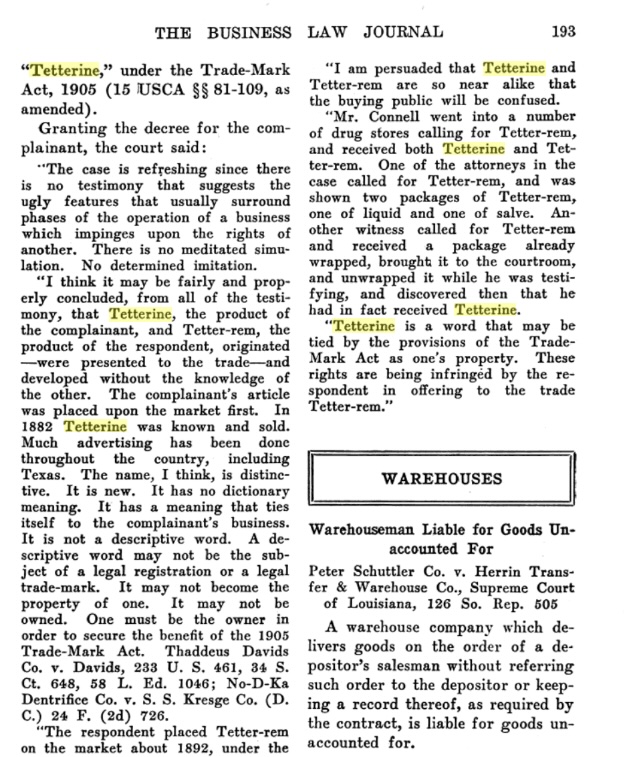
A key early reference in Tetterine History appears in a legal summary later reprinted in The Business Law Journal, stating that by 1882 the product was already known, sold, and supported by extensive advertising.9 This type of documentation matters because many nineteenth-century topical remedies appeared briefly and vanished; continued references to Tetterine across decades indicate lasting commercial identity.
“In 1882 Tetterine was known and sold. Much advertising has been done throughout the country.”9
By the early 1880s, national visibility typically depended on repeated print exposure through newspapers, circulars, almanacs, and trade outlets.10 The record suggests Tetterine was participating in that print-driven marketplace rather than remaining a strictly local or regional product.
Tetterine History and Early Co-Advertising in Remedy Portfolios (1887)
By 1887, Tetterine appears alongside other well-known remedies in a portfolio-style advertisement. An issue of the Montgomery Monitor (September 7, 1887) listed:
“S.S.S., P.P.P., Tetterine, and a full line of other Drugs, for sale.”11
This kind of grouped listing reflects common nineteenth-century co-advertising practices, in which multiple proprietary remedies were promoted together. The listing supports early marketplace association in print, but it does not by itself establish shared ownership or manufacture; primary legal and advertising records consistently identify Tetterine as a Shuptrine Company product during this era.5,12
What Skin Conditions Did Tetterine Address Historically?
Historical advertisements and trade references show Tetterine being promoted for a wide range of “tetter” category complaints.13-15 These claims reflect period marketing norms, when broad curative language was common and regulation was limited.
- Ringworm and other fungal complaints (often described generally as “tetter” conditions)
- Eczema and itching, scaly eruptions
- Ground itch
- Scalp conditions (including infant scalp issues and dandruff references)
- General itching, scaling, and visible irritation
Today, product positioning is more specific and regulated. For modern options in the Tetterine line, see Green Antifungal Ointment, White Antifungal Ointment, and Tetterine Soap.
Manufacturing Stewardship in Tetterine History
Primary-source records, advertising, federal enforcement materials, and trademark litigation consistently identify The Shuptrine Company of Savannah, Georgia as the manufacturer and marketer of Tetterine from the late nineteenth century through the mid-twentieth century—and the brand remained a Shuptrine product until its acquisition by S.S.S. Company.5,9
Within the broader context of nineteenth-century manufacturing, purpose-built facilities and repeatable processes improved production scale and consistency. Consumers began to expect the same look, feel, and performance each time they purchased a branded ointment or soap.
Advertising and National Visibility in Tetterine History (1900–1910)
In the early twentieth century, Tetterine advertising appeared across multiple publications, including the Lutheran Evangelist, the Methodist Advocate Journal, and American Druggist.8,14,15 These placements reflect sustained national marketing rather than isolated local promotion.
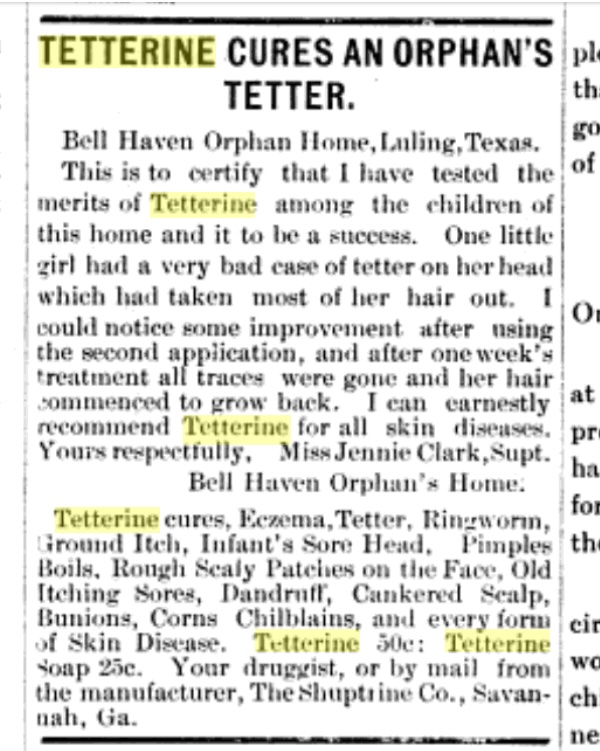
Many ads used narrative endorsements (including references to institutions such as orphan homes) and often paired Tetterine Ointment with Tetterine Soap.14,15 This pairing suggests an early brand-extension strategy: one product addressed topical application while the companion soap reinforced routine use and encouraged repeat purchases.
Ingredient and Formulation Evolution in Tetterine History
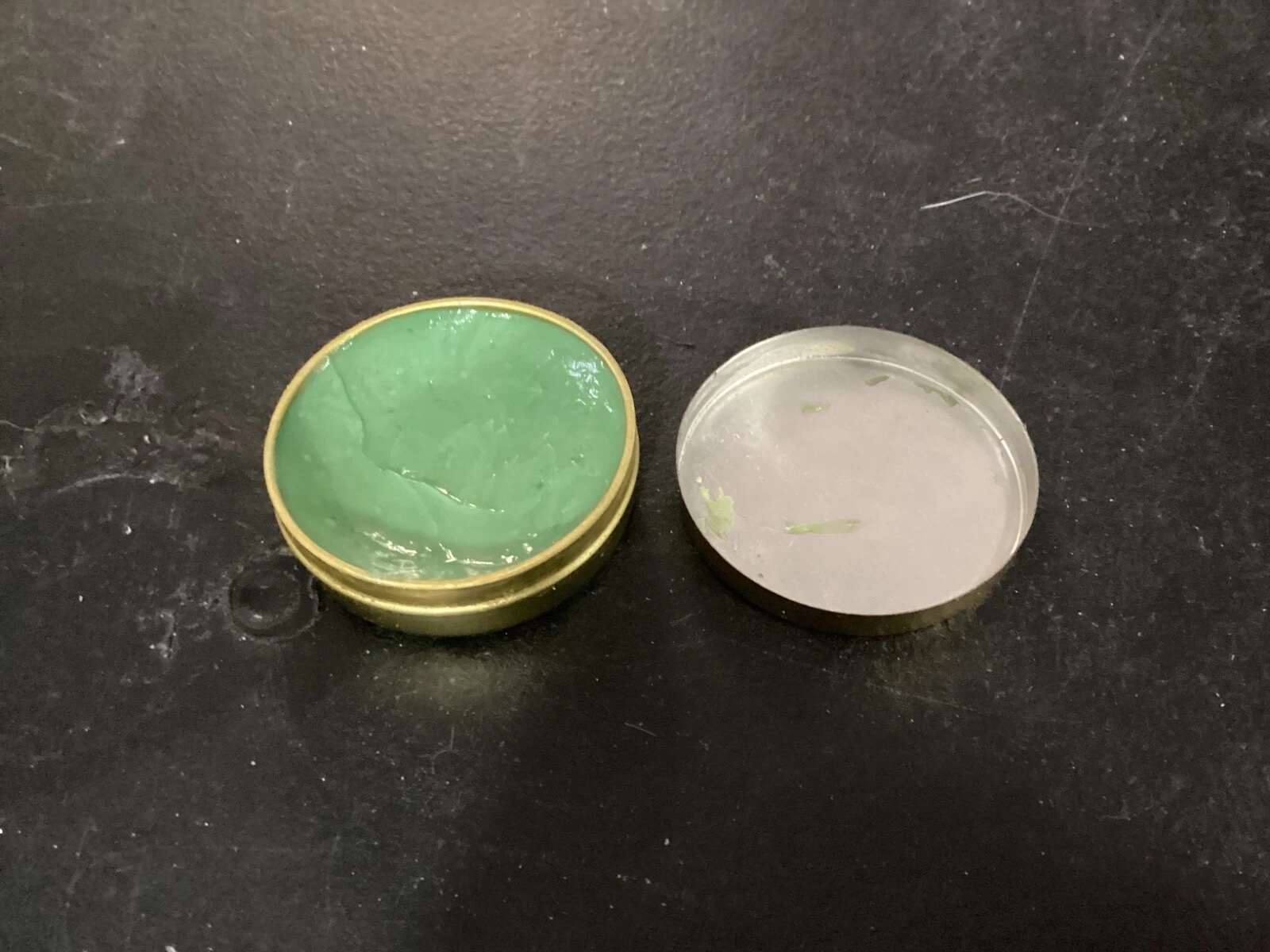
As legislation for topical dermatological preparations increased, labeling practices evolved from broad “cure” language to clearer ingredient disclosure.16,17 Some later historic Tetterine packaging and secondary records indicate the use of ingredients associated with common topical practice of the period, including salicylic acid (a keratolytic used to soften thickened or scaly skin) and boric acid (used historically for antiseptic purposes in some topical preparations).18
Important note: The image below is an open tin product photo (not a close-up of printed ingredient text). For ingredient documentation, rely on the packaging label image(s) or archived print records.
The shift from generalized claims to more standardized disclosure reflects the growing influence of federal food and drug regulation and changing expectations for OTC products. By the mid-1960s, pharmaceutical companies were required to display ingredient lists on products and provide evidence that their products met claims and did not cause harm.16,17
Then vs Now: Antifungal Care and Tetterine History
Then: In the nineteenth and early twentieth centuries, many skin complaints were grouped under broad terms like “tetter.” Remedies were marketed to relieve symptoms (itching, scaling, eruptions) and promoted through testimonials and broad, curative claims.
Now: Modern antifungal care is based on clearer differentiation of fungal vs inflammatory conditions, standardized manufacturing, and regulated OTC labeling. Consumers also rely on consistent product information and specific use directions.
In this “then vs now” context, Tetterine’s long-running presence is notable: it survived the shift from the patent-medicine era into a modern regulated marketplace, while maintaining recognizable brand continuity.
Federal Reform and Misbranding Proceedings in Tetterine History (1914–1915)
As enforcement of the Pure Food and Drugs Act, initially passed in 1906, expanded, federal authorities increasingly examined exaggerated therapeutic claims made by proprietary remedies.16 A federal Notice of Judgment in 1914 referenced Tetterine in connection with labeling language and broad “antidote” claims.5
Records associated with this enforcement period document the seizure of packaged goods and resolution through bond and compliance rather than a criminal conviction,5 reflecting how many products transitioned into stricter labeling environments during reform-era oversight.
This episode is best understood as part of a national regulatory transition: while many brands disappeared under scrutiny, Tetterine continued in commerce by adapting to clearer standards.
Tetterine Brand and Ownership Journey
Trademark Protection and Brand Distinctiveness in Tetterine History (1930)
In Shuptrine Co. v. Eucaline Medicine Co. (1930), a federal court examined whether “Tetterine” was confusingly similar to a competing product name (“Tetter-rem”). The court treated Tetterine as a distinctive brand name with established commercial identity rather than a merely descriptive term.12 This strengthened its legal protection and clarified the risk of consumer confusion when similar names entered the marketplace.
From a brand-history standpoint, the case underscores how decades of advertising, distribution, and consumer familiarity can transform a product name into a protectable trademark—especially in crowded remedy categories.
Trademark Transfer (Late 20th Century)
Documentation from the United States Patent and Trademark Office shows Tetterine switched hands from the Shuptrine Company to S.S.S. Company in 1989.20 Tetterine officially joined S.S.S. Company's portfolio of wellness products.
Scientific Oversight and Survival
1930s Enforcement
By the 1930s, oversight intensified further, including Federal Trade Commission (FTC) scrutiny of advertising practices.16 During this era, scientific and clinical research was increasingly expected across the proprietary medicine industry.
While S.S.S. Company conducted laboratory and clinical work on its own products during this period, the primary-source record does not attribute those specific research programs to Tetterine prior to its acquisition.19
Modern Era Regulation
In 2022, the United States Food and Drug Administration (FDA) passed the Modernization of Cosmetics Regulation Act (MoCRA), which provided the first updated guidance on drug and cosmetic products since the mid-1930s. MoCRA required companies to report adverse events, list ingredients, register processing facilities, and more to ensure consumer safety.21
As an FDA-regulated product, Tetterine is manufactured and marketed in accordance with MoCRA guidelines.6 Tetterine's transformation exemplifies the changing nature of pharmaceutical advertising and regulatory scrutiny throughout the last century.
Packaging Evolution in Tetterine History: Metal Tins, Labels, and Shelf Recognition
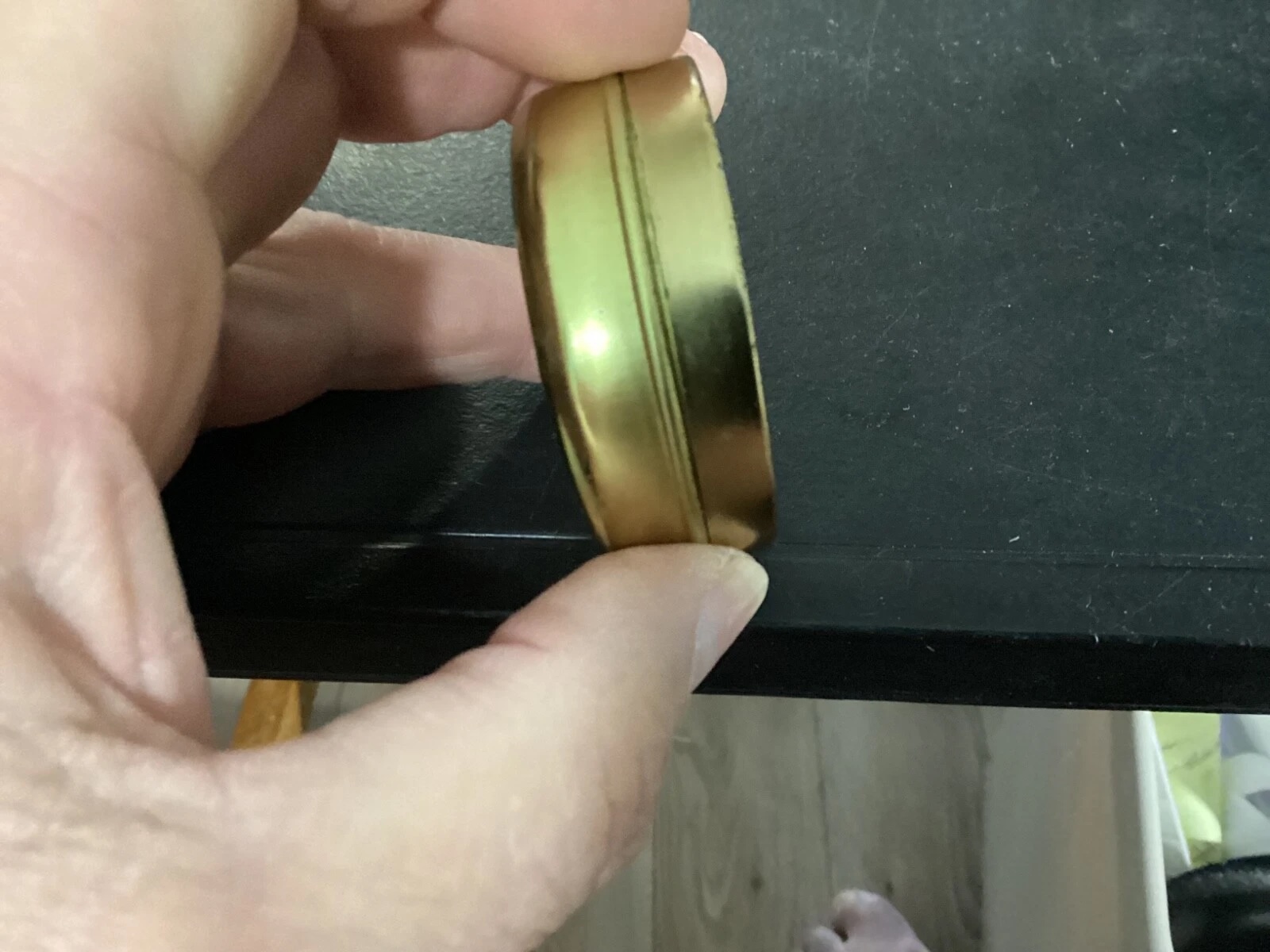
Packaging played a major role in long-term consumer recognition. Early Tetterine products used durable screw-top metal tins designed for portability and reuse. Lid branding and consistent naming supported shelf visibility in drugstores and general stores, where buyers often selected products quickly from crowded displays.
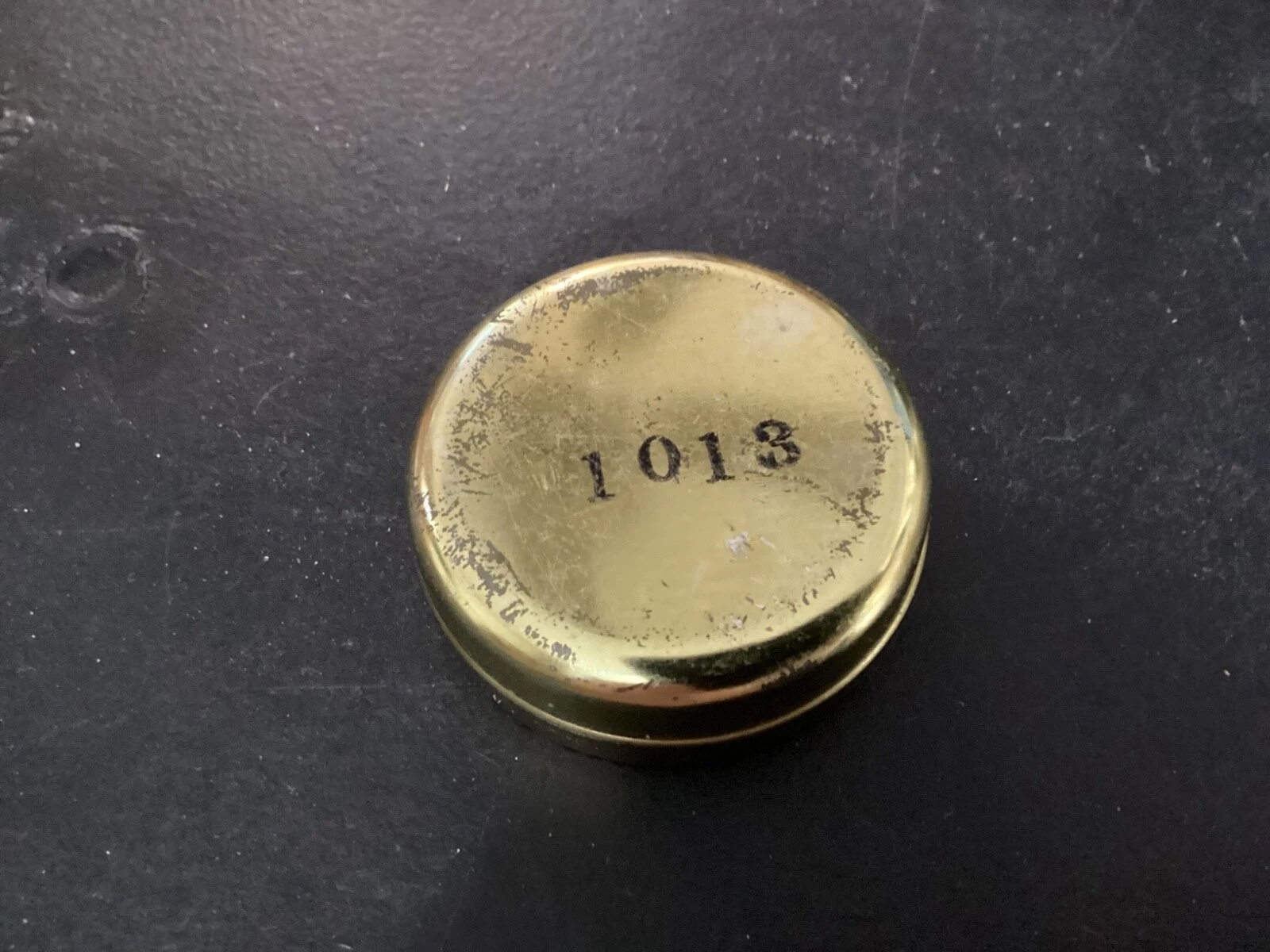
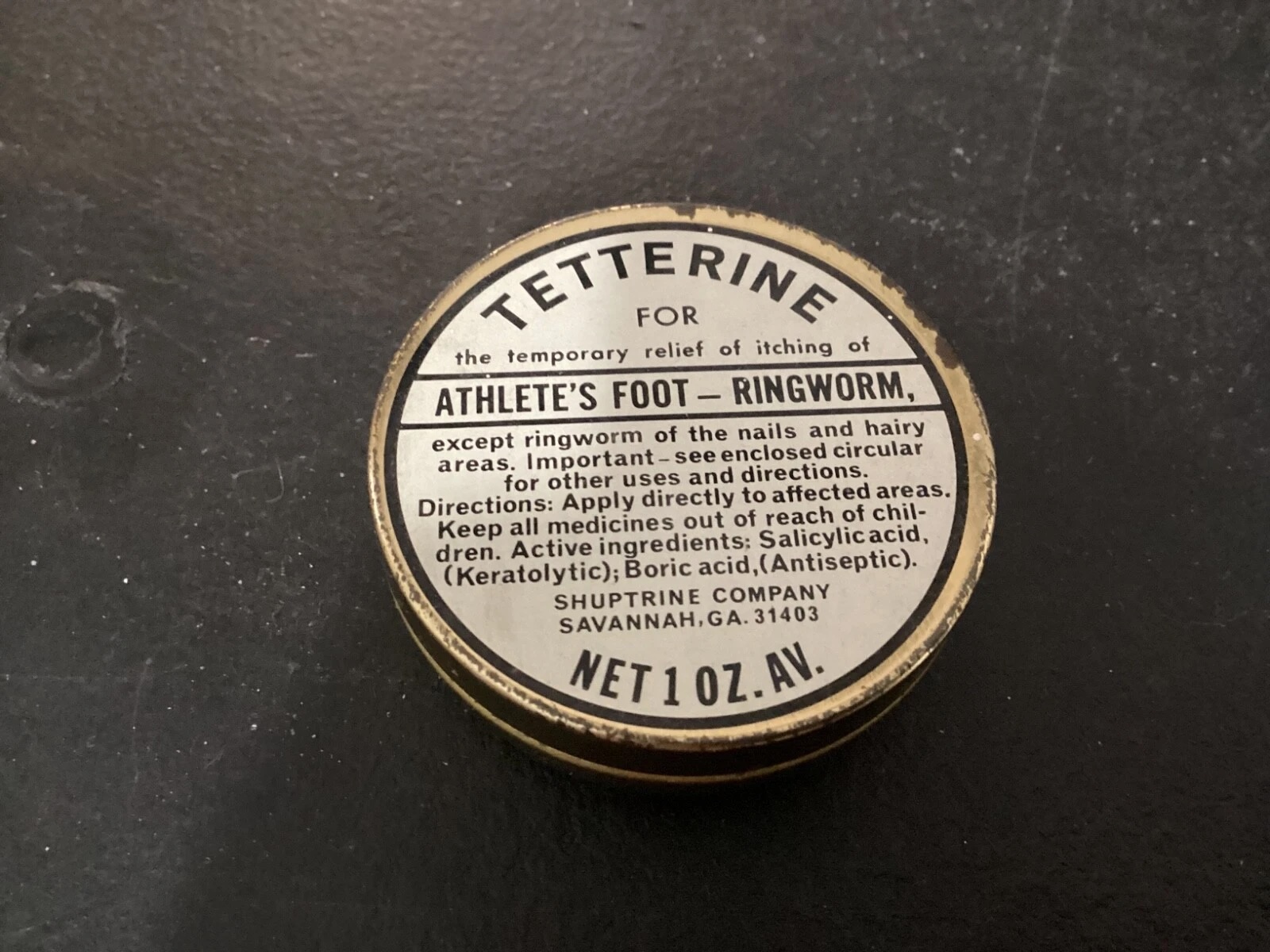
In later eras, packaging increasingly emphasized standardized labeling conventions and clearer product positioning as OTC regulation matured.
Tetterine Historical Timeline

| Pre-1880s | “Tetter” used broadly in medical and commercial language for scaly, itching skin diseases.2 |
| 1882 | Documented as known and sold, with extensive national advertising described in the later legal summary.9 |
| 1887 | Portfolio listing: “S.S.S., P.P.P., Tetterine” in period advertising.11 |
| 1900–1910 | National visibility through religious/trade publications and testimonial-style advertising.14,15 |
| 1914–1915 | Referenced in federal Notice of Judgment proceedings connected to labeling claims during reform-era enforcement.5 |
| 1930 | Federal trademark litigation affirms brand distinctiveness (confusion concerns with similar naming).12 |
| 1930s | Cited scientific/clinical oversight during heightened advertising scrutiny and enforcement.17 |
| Mid-20th Century | Continuity period: Tetterine continued to be manufactured and marketed by The Shuptrine Company, maintaining long-established brand identity through mid-20th-century market and regulatory change, until its acquisition by S.S.S. Company in 1989.20 |
| Today | Continues as a regulated OTC dermatological line within the S.S.S. Company portfolio. |
Taken together, these milestones show a rare pattern: early commercial documentation, sustained advertising visibility, survival through regulatory reform, and continued brand presence in a modern OTC environment. That continuity is central to what makes Tetterine History distinct from many short-lived topical remedies of the same era.
Tetterine® Today: Modern Products and How They Fit the History
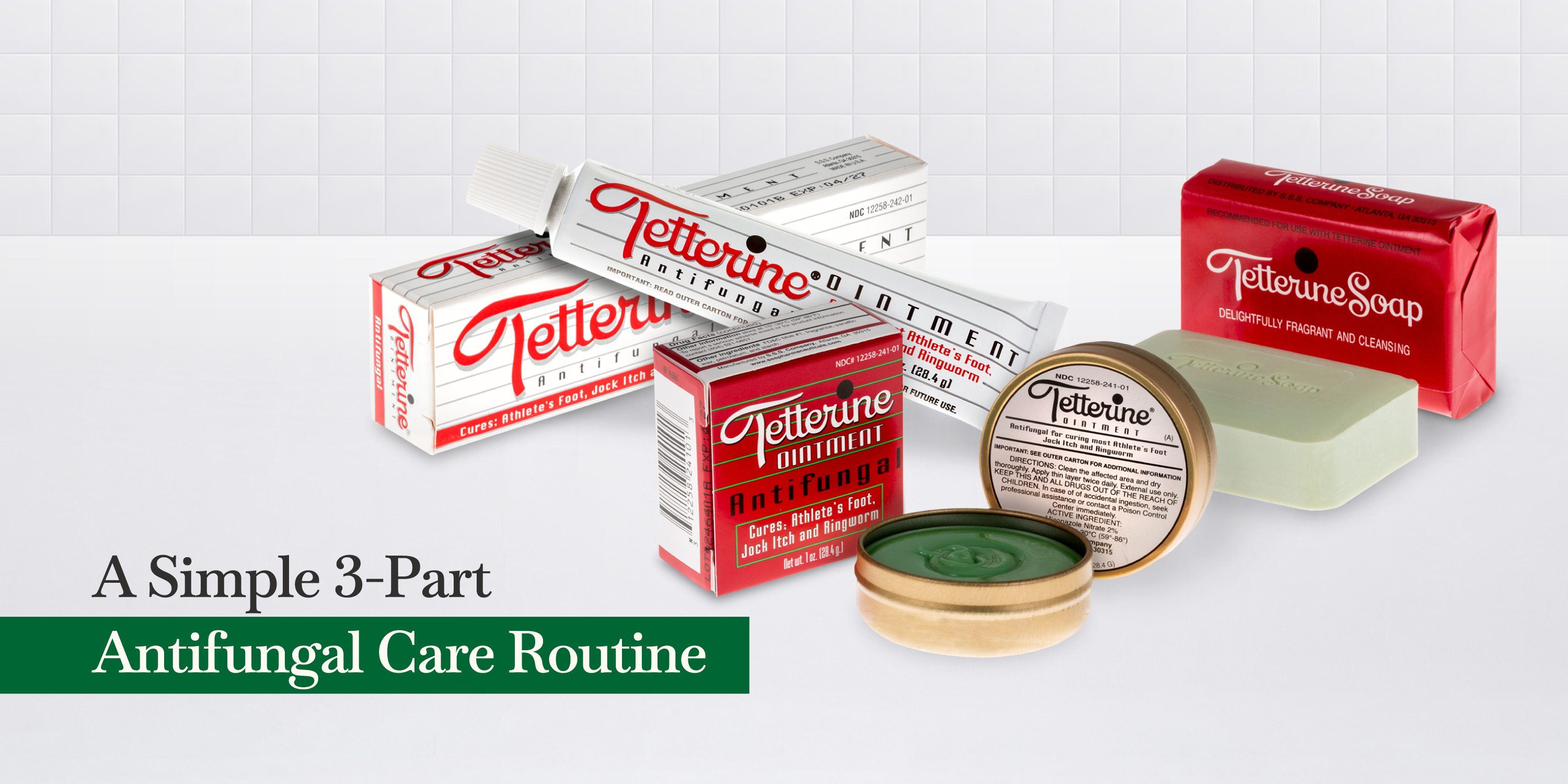
Today, Tetterine remains part of the S.S.S. Company dermatological portfolio. Current offerings include:
From vintage metal tins to modern regulated formulations, Tetterine History illustrates how a legacy dermatological brand can adapt through shifting standards, advertising reform, ingredient disclosure expectations, and federal oversight—while maintaining recognizable continuity for generations of consumers.
References
- Mowat BA and Werstine P (editors). The Tragedy of Hamlet, Prince of Denmark. Folger Shakespeare Library. Accessed April 7, 2026. https://www.folger.edu/explore/shakespeares-works/hamlet/.
- Millingen JG. Curiosities of the Medical Experience. Richard Bently, London, 1839.
- Dailey JW. Transitions in drug discovery. Britannica. Accessed April 7, 2026. https://www.britannica.com/technology/pharmaceutical-industry/Transitions-in-drug-discovery.
- Cramp A (editor). Articles on the Nostrum Evil, Quackery and Allied Matters Affecting the Public Health. The American Medical Association, Chicago, 1921.
- Alsberg CL. Service and Regulatory Announcements, February 1914. U.S. Department of Agriculture, Bureau of Chemistry. Government Printing Office, Washington, D.C., 1915.
- National Drug Code Directory. U.S. Food and Drug Administration. Accessed April 3, 2026. https://www.accessdata.fda.gov/scripts/cder/ndc/dsp_searchresult.cfm.
- Janssen WF. The story of the laws behind the labels. United States Food and Drug Administration. Published Jun 1981. Accessed April 6, 2026. https://www.fda.gov/media/116890/download.
- Tetterine. American Druggist. Published 1923. Accessed April 6, 2026. https://www.google.com/books/edition/American_Druggist/eLxUbG2nG7oC?hl=en&gbpv=1&bsq=tetterine&dq=tetterine&printsec=frontcover.
- Brady JE (editor). Trade-mark “Tetterine” held infringed. The Business Law Journal. 1930;16(1):192-193.
- Helfand WH. Advertising health to the people. Popular Medicine in America, 1800-1900. Accessed April 6, 2026. https://www.popularmedicine.amdigital.co.uk/Explore/Essays/AdvertisingHealth.
- Biddle JA. The Montgomery Monitor, September 7, 1887, image 3. Georgia Historic Newspapers. Published September 7, 1887. Accessed April 6, 2026. https://gahistoricnewspapers.galileo.usg.edu/lccn/sn89053231/1887-09-07/ed-1/seq-3/.
- Shuptrine Co. v. Eucaline Medicine Co. No. 3243-500. The Federal Reporter. 1930;40(2d):303. https://www.google.com/books/edition/The_Federal_Reporter/NQ04AAAAIAAJ?hl=en&gbpv=1&bsq=tetterin.
- S.S.S. Company. Internal data.
- Praises Tetterine for eczema, page 17. The Lutheran Evangelist. Published April 29, 1909. Accessed April 6, 2026. https://www.google.com/books/edition/Lutheran_Evangelist/s0_z3CSX5I4C?hl=en&gbpv=1&dq=tetterine&pg=RA5-PA17&printsec=frontcover.
- Tetterine cures an orphan’s tetter. The Methodist Advocate-Journal. Published March 18, 1909. Accessed April 6, 2026. https://www.google.com/books/edition/Methodist_Advocate_Journal/iWUTTJADKbEC?hl=en&gbpv=1&dq=tetterine&pg=RA10-PA11&printsec=frontcover.
- Public Law 87-781, October 10, 1962. United States Government. Published October 10, 1962. Accessed April 9, 2026. https://www.govinfo.gov/content/pkg/STATUTE-76/pdf/STATUTE-76-Pg780.pdf.
- Meadows M. Promoting safe and effective drugs for 100 years. FDA Consumer Magazine. 2006. https://www.fda.gov/files/Promoting-Safe-and-Effective-Drugs-for-100-Years-(download).pdf.
- Ingredient list, vintage Tetterine tin. eBay.com. Accessed April 9, 2026. https://www.ebay.com/itm/267267944554?utm.
- Grenberry WR. S.S.S. History of the Company and its Products, 1826-1942. S.S.S. Company, 1942.
- Harper B. Trademark request no. 0265140. United States Department of Commerce Patent and Trademark Office. Mailed May 9, 1990. Accessed April 13, 2026. https://uspto.report/TM/71288396.
- Modernization of Cosmetics Regulation Act of 2022 (MoCRA). United States Food and Drug Administration. Accessed April 1, 2026. https://www.fda.gov/cosmetics/cosmetics-laws-regulations/modernization-cosmetics-regulation-act-2022-mocra.